


Whether she is calling to you from the waves or staring you down from the shadows, the ‘monster’ is always just a woman who refuses to be your victim.
You know her.
The snake-haired monster. The woman whose gaze could kill. A horror, a villain, a punishment waiting to happen. But what if Medusa isn’t the monster?
Medusa’s story is one of the most misunderstood in mythology. She’s been depicted as the ultimate femme fatale, a creature so dangerous that simply looking at her spells certain doom. But if you dig a little deeper, her story is less about monstrous women and more about male fear and control. And, quite frankly, it’s infuriating.
So, let’s take a fresh look at the original “bad girl” of Greek mythology and see if maybe… just maybe … she wasn’t the villain at all.
Medusa: From Beautiful to Banished
Before she was a nightmare, she was a priestess of Athena, sworn to a life of devotion and purity. She was also, according to some versions, stunningly beautiful … so much so that she caught the eye of Poseidon, god of the sea.
And that’s when things took a turn. Because instead of wooing her, Poseidon assaulted her in Athena’s temple. A horrifying crime, right? Well, guess who got punished? Not Poseidon. No, Medusa was the one who bore the consequences – Athena transformed her into a Gorgon, giving her that iconic head of snakes and making her so terrifying that no man could even look at her without turning to stone.
(Oh, and she got exiled. Because why not kick a girl when she’s down?)
In a tragic twist, Medusa’s “curse” actually became her shield, men couldn’t harm her if they couldn’t look at her. Her survival depended on her ability to make men afraid of what she had become.

But the story doesn’t end there. Enter Perseus, the Greek hero who was sent on a quest to kill Medusa. With the help of Athena and Hermes (because apparently, even gods feared her power), he used a mirror-like shield to avoid looking directly at her, swooped in, and cut off her head while she slept.
So, just to sum up: Medusa was assaulted, punished for it, then murdered in her sleep. And yet, she’s the villain?
Because there is nothing more dangerous than a woman who refuses to stay a victim.
Why Medusa Was Vilified
If we strip away the supernatural elements, Medusa’s story is about silencing women who survive male violence. Her transformation wasn’t just a curse; it was a way to make her untouchable, to take away her ability to be seen as a victim. And when she finally became powerful enough to protect herself? She had to be taken down.
The Greeks weren’t subtle. Men loved hero stories, and they feared powerful women. Medusa was the ultimate scapegoat: the woman who could never be controlled. And if there’s one thing a patriarchal society loves, it’s a reason to keep women in check.
Psychology & Feminist Reinterpretation: Medusa as the Survivor
Freudian Take: The Fear of Female Power
Sigmund Freud (because of course he did) argued that Medusa was the ultimate male fear, a woman so powerful that simply looking at her was enough to strip a man of his strength. Her petrifying gaze? A metaphor for the loss of control men feel in the face of female power. The idea was that her petrifying gaze symbolized the fear of losing control, power, or masculinity. (Translation: She makes men nervous, so they demonized her.)
Jungian Take: The Shadow Self
Carl Jung would say that Medusa represents the shadow feminine, the part of a woman’s psyche that holds repressed rage, power, and truth. She isn’t just a victim; she’s the embodiment of female rage. And in patriarchal myths, rage must be “defeated” or suppressed.
Feminist Take: Medusa as an Icon of Resistance
Medusa has been reclaimed in modern feminist thought as a symbol of survival, resilience, and female power. Her story mirrors real-world experiences of women who speak out against assault and are punished for it. Her gaze, so feared by men, becomes a metaphor for women looking back, refusing to be silenced, refusing to be passive.
So, is Medusa a monster? Or is she a woman who was wronged, who found her own way to fight back, and whose story was twisted to fit a narrative that made men feel safer?
Medusa in Pop Culture: From Villain to Icon
Medusa’s influence stretches far beyond Greek mythology. She appears in art, literature, and even fashion (Versace, anyone?). But the way she’s depicted depends on who is telling the story.
- In Classical Art – Medusa is typically monstrous, reinforcing the idea that she’s something to be feared.
- Renaissance & Baroque Paintings – Artists like Caravaggio painted her as a severed head—because nothing says “powerful woman” like being displayed as a trophy.
- Modern Literature & Feminist Art – Medusa is now seen as a symbol of feminine rage and survival. Writers like Hélène Cixous reframe her as a woman who was punished for being too powerful, too unapologetic.
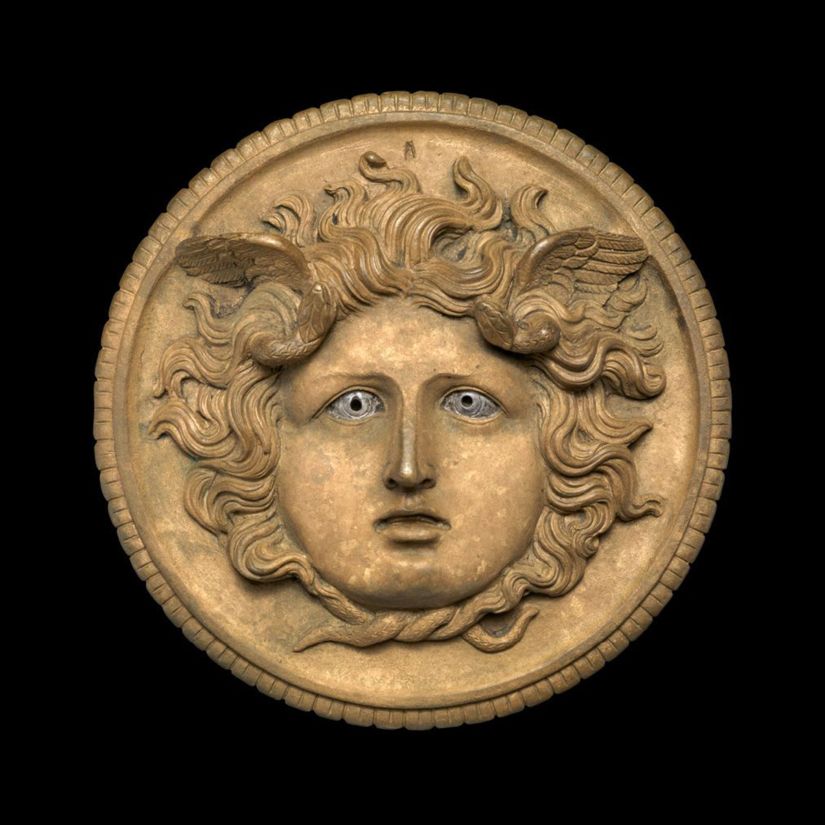


One of the most interesting shifts? Women now wear Medusa’s image as a badge of honor. She’s no longer just a warning, she’s a rebellion. From feminist art to tattoos to modern retellings, Medusa represents the rage of women who refuse to be reduced to mere victims, but instead transform that rage into force.
Medusa is a reminder that survival itself is power.
Final Reclamation: Medusa Was Never the Monster
Medusa’s story is a mirror held up to society. She reflects the way women’s pain is dismissed, how their power is feared, and how the narratives about them are twisted to serve the status quo.
But today, Medusa is more than a myth; she’s a movement. A reminder that looking back – staring down the forces that try to silence you – is not a curse. It’s a revolution.
So, the next time someone calls a woman “too angry,” “too intimidating,” or “too much”- ask yourself, what it is they’re really afraid of.
Because Medusa never asked to be feared. But if fear is the only thing that keeps them from hurting her again?
Then let them turn to stone.
Always,
Your Trusted Friend 🖤
Bogart, Jo. “Women in Myth and Their Stories Retold: A Beginner’s Guide to Medusa.” Elon University, Elon University, 2025, https://www.elon.edu/u/academics/first-year-writing/writing-contest/2022-2023-journal/women-in-myth-and-their-stories-retold-a-beginners-guide-to-medusa/. Accessed 21 February 2025.
Garber, Marjorie, and Nancy J. Vickers, editors. The Medusa Reader. Routledge, 2003.
Rabinowitz, Nancy Sorkin. Anxiety Veiled: Euripides and the Traffic in Women. Cornell University Press, 1993.
Discover more from The Clever Confidante
Subscribe to get the latest posts sent to your email.

