


Few names evoke the image of dangerous seduction quite like Salome.
A girl who danced for a king and, in return, asked for the head of a prophet on a silver platter. She is the embodiment of the femme fatale, mysterious, manipulative and deadly.
Or so we’ve been told.
But what if Salome was never truly in control?
What if the girl history remembers as a temptress was really just another pawn in a world ruled by powerful men?
(And yet, she’s the one who got blamed? Of course she was.)
So who was Salome, really?
Salome appears in the New Testament, specifically in the Gospels of Matthew and Mark. She is the daughter of Herodias, who left her first husband to marry Herod Antipas, the ruler of Galilee.
This marriage was considered scandalous (because of the whole leaving-her-husband thing), and John the Baptist openly condemned it.
That didn’t sit well with Herodias, who wanted John silenced. But Herod, despite being a tyrant, actually feared John and hesitated to kill him.
So who gets dragged into this mess?
A teenage girl.
Enter Salome.
During a lavish banquet, Salome performed a dance that so delighted Herod (this is Salome’s stepdaddy, remember) that he promised her anything she wanted, up to half his kingdom.
After consulting with her mother, Salome asked for John the Baptist’s head on a platter.
Was this a power move, or obedience?
The idea wasn’t hers. The Gospel of Mark makes it clear: Herodias had been waiting for a chance to get rid of John. His opposition to her marriage threatened her position, her marriage, her security, and her power.
And Salome?
A 12-year-old girl, standing between a vengeful mother and a reckless king, two powerful adults who controlled her fate.
What else was she supposed to do?
Fear and loyalty are powerful motivators, especially when the person you see scrambling for survival is your own mother.


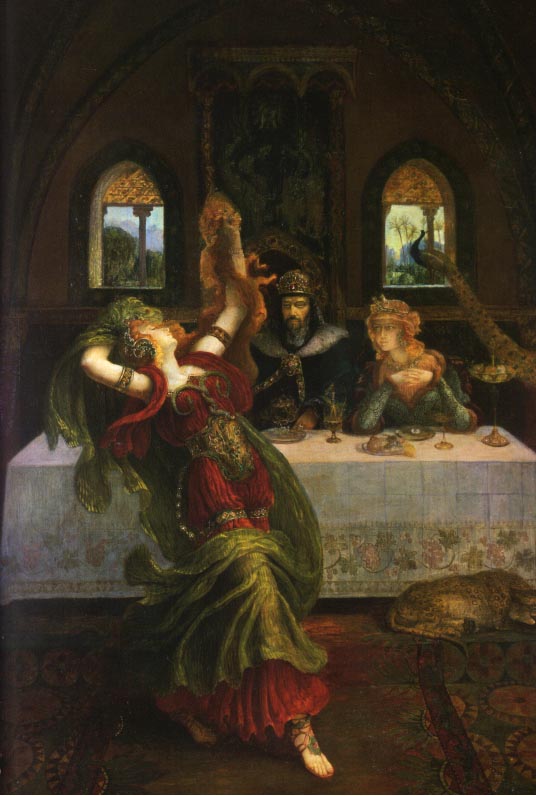
Herod was reluctant but ultimately granted the gruesome request. John was beheaded, and Salome became the ultimate seductress, a girl whose beauty was so mesmerizing that it led to murder.
Except…
Nowhere in the Bible is Salome’s dance actually described
That detail?
It was added later.
And in every retelling after, it became a performance of ultimate seduction, because apparently 12-year-old girl dancing at a party can’t just be a 12-year-old girl dancing at a party.
(Men really do like making this weird).
Salome is often remembered as a manipulator, using her sensuality to twist a king’s desires to her will. But was she truly the mastermind?
Or was she just a child, doing as she was told?
Let’s break it down:
- She was young. Most historians agree Salome was between 12 and 14 years old at the time of John’s execution. A girl dancing at a party is not exactly a criminal mastermind.
- The idea wasn’t even hers. It was Herodias, her mother, who told her to ask for John’s head. Salome didn’t plot or scheme, she obeyed.
- Herod held all the power. He made the reckless offer. Salome merely accepted it under pressure.
Salome wasn’t a grown woman using seduction as a weapon, she was a child.
Yet, history remembers her as a femme fatale, as if a preteen girl had the power to manipulate a king.
Yet, in most retellings, Salome is the villain.
Not Herod, the man who made a reckless promise.
Nor Herodias, the woman who orchestrated the execution.
Just Salome, the child who followed orders.
It is conveniently forgotten that in all this mess she is a child manipulated by the adults around her.
(Shocking. Truly.)
Salome isn’t just rewritten, she is aged up, sexualized and blamed for the desire of the men around her.
And she isn’t alone.
Anne Boleyn arrived at the English court as a teenager and was later blamed for seducing Henry the VIII.
Marie Antoinette was sexualized in propaganda at 14 and then executed for corrupting France, even though she was a child bride married into a doomed monarchy.
Britney Spears, Brooke Shields, and countless other child stars have been sexualized, exploited, and then blamed and punished for it.
Told it’s their fault. Always.
The real scandal isn’t that a young girl danced at a banquet.
The real scandal is that a grown man sexualized it and then blamed her for his own desires.
The Problem With The Femme Fatale Narrative
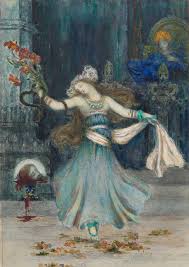
History really does love a woman who is both beautiful and deadly, but it loves her only when she serves as a cautionary tale.
Salome fits perfectly into the femme fatale narrative, not because she actually was one, but because she was young, female, and history needed a villain.
If women are quiet, they are innocent.
If they exist in the realm of desire, they are dangerous.
If they hold any power at all, they must be silenced.
And so, the story was rewritten.
Because the alternative was that the real danger wasn’t her dance, but the men who projected desire onto a child was too much to admit.
Salome in Modern Culture
Over the centuries, Salome has been eroticized and vilified across art, literature, and media. Her image became one of a femme fatale, rather than a frightened powerless girl.
Why does history insist on portraying a child as a seductress?
Salome’s story isn’t just about seduction or death.
It’s about who holds power and who gets blamed.
A girl dances.
A king makes a reckless promise.
A mother seizes an opportunity.
But only one name becomes infamous.
Salome.
Herod kept his throne. Herodias disappeared from the narrative.
But Salome became a symbol of dangerous female sexuality.
Because history loves a woman who is both beautiful and deadly, but only when she serves as a cautionary tale.
So was Salome a cunning manipulator?
Or was she just a child caught between a king’s arrogance, a mother’s vengeance, and a world that always blames the girl?
Because it’s not just women who are blamed.
It starts with girls.
Always,
Your Trusted Friend 🖤
Discover more from The Clever Confidante
Subscribe to get the latest posts sent to your email.

