

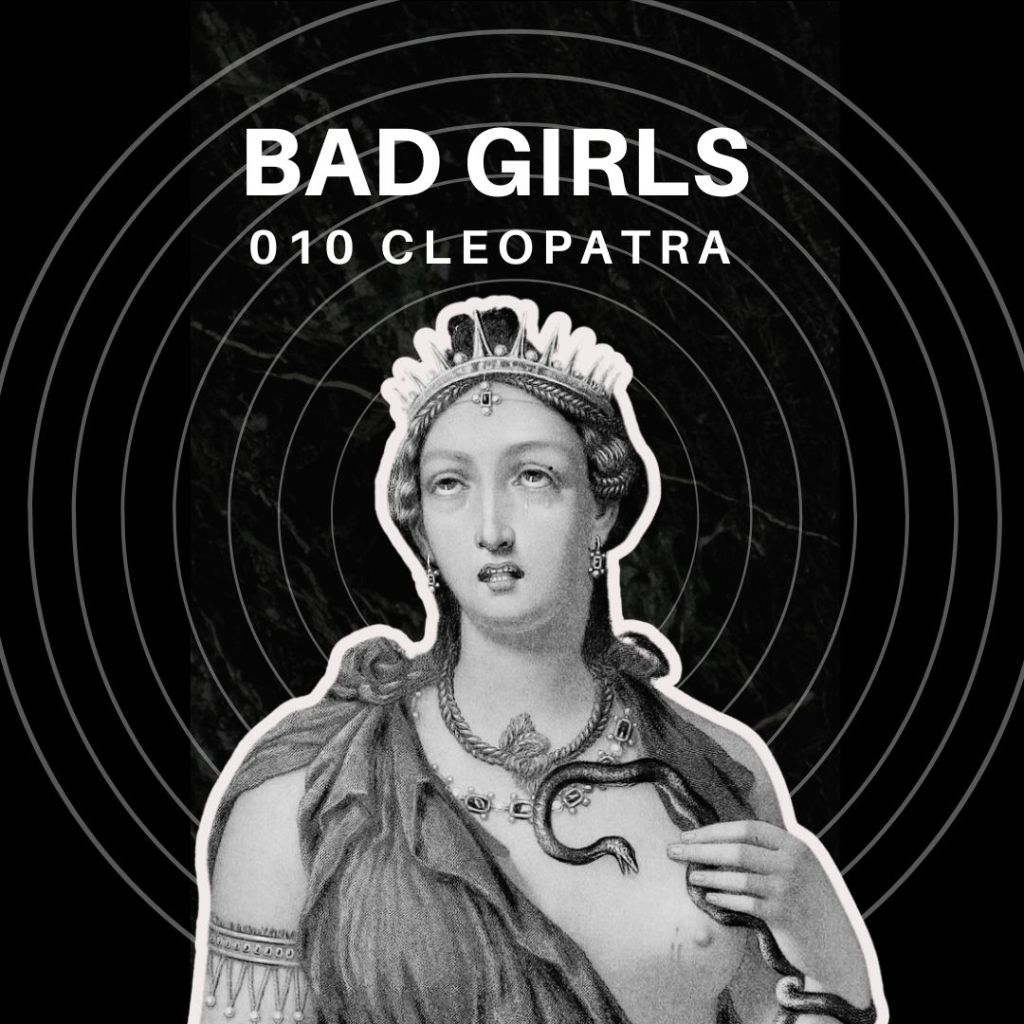
Cleopatra was one of the most brilliant rulers in history.
But you wouldn’t know it from the way history tells her story.
When you hear the name Cleopatra, what comes to mind?
The seductress who ensnared Julius Caesar and Mark Antony? The queen who bathed in milk and rolled herself in carpets? A woman whose beauty could topple empires?
Cleopatra has been immortalized as a romantic femme fatale, but the real story is far more complex.
She is remembered as a seductress, but she was really a ruler, a strategist, and a woman who wielded power in a world encroaching on her.
(But of course, history would rather remember her love life than her leadership.)
Who Was Cleopatra?
Cleopatra VII Philopator was the last active ruler of the Ptolemaic Kingdom of Egypt. Unlike many of her predecessors, she actually spoke Egyptian, embraced local customs, and positioned herself as a goddess incarnate.
She wasn’t just intelligent—she was a scholar, a scientist, and a gifted chemist known to experiment with poisons.
- She spoke at least nine languages, making her one of the most linguistically skilled rulers of her time.
- She revived Egypt’s economy, implemented taxation policies, and built strong trade alliances that kept her kingdom afloat.
- She held Egypt together for two decades, even as Rome threatened to consume everything around it.
And yet, when people talk about Cleopatra, they don’t mention her linguistic skills, her diplomacy, or her reforms.
They talk about who she slept with.
(Surprise, surprise.)
The Power of Perception: Seductress or Strategist?
Cleopatra’s affairs with Julius Caesar and Mark Antony are often painted as proof of her cunning manipulation, but she was really just playing power politics.
Rome was the rising superpower, and Egypt was in danger. Aligning herself with the most powerful men in Rome wasn’t just about romance, it was a survival tactic.
- Julius Caesar: Cleopatra’s relationship with Caesar secured her throne and stabilized her reign. She bore him a son, cementing her political legitimacy.
- Mark Antony: After Caesar’s assassination, she allied with Antony, creating a political and military partnership that challenged the dominance of Octavian (later Augustus) and expanded Egypt’s influence in the Eastern Mediterranean.
Did she use her charm? Probably. But do we seriously think Roman rulers were helpless against a beautiful woman?
(If so, they really shouldn’t have been running an empire.)
Cleopatra and the Roman Propaganda Machine
After Mark Antony and Cleopatra lost to Octavian in the Battle of Actium, history took a predictable turn:
The Romans needed a villain.
Cleopatra wasn’t remembered as a brilliant ruler fighting for her people—she became the foreign temptress who “bewitched” noble Roman men and led them astray.
Her leadership was erased.
Her love life was exaggerated.
Rome portrayed her as a beautiful seductress who bent men to her will by her attractiveness, but that’s not true.
Cleopatra was no beauty.
Ancient coins show her with a hooked nose, high forehead, and wide sunken eyes.
“Cleopatra was much more concerned to have a strong and dominant appearance … than to be pretty or beautiful by any feminine standards of the day,” says Sheila Ager, professor of classical studies at the University of Waterloo.
“She was sending the message that she was as good as and as valid a ruler as any of the men who had gone before her.”
Octavian made sure Cleopatra was remembered not as a queen, but as a cautionary tale. The image of her seducing Antony, of luring him away from Roman values, was the perfect propaganda to justify their defeat.
(Spoiler alert: This is the same playbook used against almost every powerful woman in history.)
One of the most famous images of Cleopatra is her death by asp bite, a poetic and dramatic end for the “temptress queen.” But how true is it?
Ancient sources differ on the exact method of her death. Some say she used a poisoned hairpin or drank a fatal potion. Others believe she was executed by the Romans, and the “asp bite” was a convenient myth to make her death more dramatic.
Regardless of the method, one thing is certain:
Cleopatra chose to die on her own terms rather than be a spectacle in Octavian’s victory parade.
(And that is the move of a ruler, not a seductress.)
Cleopatra in Pop Culture
Cleopatra hasn’t faded away, she’s been reshaped to fit the fantasies of different eras:
- In Renaissance paintings, she was the doomed romantic heroine.
- In 19th-century literature, she was the ultimate seductress.
- In Hollywood, she was Elizabeth Taylor in a gold headdress.


Rarely is she portrayed as what she actually was: one of the most capable and intelligent rulers of the ancient world.
Cleopatra was so much more than a lover; she was a leader.
She wasn’t just beautiful.
She was brilliant.
And yet, she has been reduced to a story about men and the power they supposedly lost to her charm.
Was she ruthless? Absolutely.
Did she make strategic alliances? Of course.
But men in power do the same things every day without being remembered as manipulative sirens who led nations to ruin.
History is rarely kind to ambitious women.
Always,
Your Trusted Friend 🖤
Duggan, Graham. “6 Things You Never Knew About Cleopatra.” CBC. CBC/Radio-Canada, 10 December 2020. https://www.cbc.ca/documentaries/the-nature-of-things/6-things-you-never-knew-about-cleopatra-1.5834648. Accessed 14 March. 2025.
Forman, Werner. “Cleopatra Facts: Her Life, Loves & Children, Plus 6 Little-Known Facts.” HistoryExtra, Immediate, 10 May 2023, https://www.historyextra.com/period/ancient-egypt/cleopatra-facts-ancient-egypt-beauty-life-death-egyptian-roman-caesar/. Accessed 21 February 2025.
Goldsworthy, Adrian. Cleopatra: The Last Queen of Egypt. Yale University Press, 2010.
Roller, Duane W. Cleopatra: A Biography. Oxford University Press, 2010.
Discover more from The Clever Confidante
Subscribe to get the latest posts sent to your email.

